

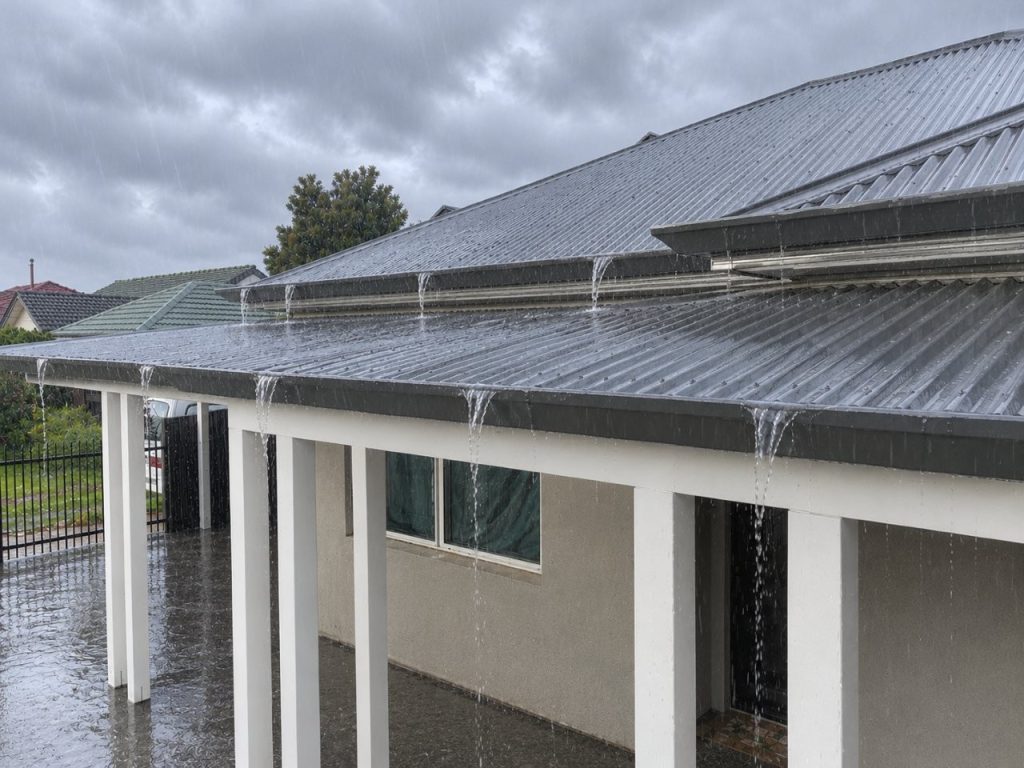
Why Are My Gutters Overflowing Even After Cleaning?
Overflow that continues after a thorough clean comes from the downpipes and stormwater drainage, or from the gutters and the roof edge they’re fixed to. Each needs a different fix.
Tracking it down early matters, because water spilling over or behind the gutter can rot the timber fascia (the board along the roof edge that your gutters are attached to) and get into the eaves. Below, we explain the common causes and how to tell whether a repair will do or it’s time for new gutters.
Quick Answer
Why Clean Gutters Can Still Overflow
Cleaning only clears the guttering itself, but rainwater still has to drain down the downpipes and into the stormwater system. A blockage anywhere along that path backs water up and over the gutter edge, even when the channel is spotless. Gutters that are too small or have inadequate fall for the roof will also overflow, however clean they are.
Some overflow is intentional, because under the National Construction Code (NCC), most new eaves gutters need an overflow measure, such as slots along the front face or a controlled gap at the back. These let excess water escape away from the house in an intense downpour instead of backing up into the eaves. If your gutters have front slots and water only spills from them during very heavy rain, the system is working as designed.
Water that spills in moderate rain, or runs behind the gutter into the eaves, means there’s a fault. Where it escapes is the best clue to the cause.
| What you see | What’s causing it |
|---|---|
| Water spilling near a downpipe | Blocked downpipe or stormwater drain |
| Water sitting in the gutter after rain | Incorrect fall or a sagging section |
| Overflow along the whole run in heavy downpours | Gutters or downpipes too small for the roof |
| Overflow concentrated below a roof valley | Too much water entering one section |
| Water running down behind the gutter | Loose brackets or damaged fascia |
| Light spilling from front slots in very heavy rain | Built-in overflow working as designed |
More than one of these can happen at once, so it pays to check the whole system rather than stopping at the first fault you find.
6 Reasons Your Gutters Keep Overflowing After Cleaning
1. Blocked Downpipes Are Restricting Water Flow
Downpipes can block even when the gutter channel is clear. Leaves and silt collect at the outlet (where the gutter drains into the downpipe) and in the bends of the pipe. Over the drier months, debris builds up unnoticed until the first heavy storm washes it into the pipe and jams it.
Blockages also form in the underground stormwater line, where you can’t see them. If water backs up even though the outlet looks clear, the problem is further down.
Cleaning the gutter channel again won’t shift a blockage inside the downpipe. The line needs to be flushed, and the stormwater connection checked while it’s open.
2. Your Gutters Don’t Have the Correct Fall
Gutters need a slight slope, called the fall, to carry water towards the downpipes. Under the NCC, eaves gutters need a minimum fall of 1:500, or a 2 mm drop per metre, unless they’re fixed to a metal fascia.
Gutters lose their fall over time as brackets loosen or the fascia shifts, and some were never set out correctly in the first place. A flat section holds water, while a run that slopes away from the outlet sends it to the wrong end, where it spills over.
A garden hose is the easiest way to check. On a dry day, run water into the high end of the gutter (with someone holding the ladder) and watch where it goes. Water that sits in the gutter or runs away from the outlet means the fall is wrong, while water that backs up at the outlet means the downpipe is blocked. If the gutter and fascia are in good condition, re-setting the brackets to the correct fall fixes it.
3. Your Gutters Are Too Small for the Roof
Gutter size needs to match the area of roof draining into it and how hard rain falls in your area. Undersized gutters that cope with steady winter rain will still overflow in a short, intense summer storm, when a lot of water arrives at once.
An extension that drains into the original gutters adds water they weren’t designed to carry. Steep roofs make it worse, because fast runoff can shoot straight over the front edge of the gutter.
The fix is a larger gutter profile or extra outlets, sized to suit the area of roof each gutter drains.
4. There Aren’t Enough Downpipes
A correctly sized gutter will still overflow if water can’t get out fast enough. The NCC limits each downpipe to a maximum of 12 metres of gutter, so a long run relying on a single outlet is a common culprit.
Downpipe size matters as well, since a small downpipe can only take so much water, however large the gutter feeding it.
Adding a downpipe or moving an outlet is the standard fix. Before any new outlets go in, the stormwater system needs to be checked for the extra flow.
5. Your Gutters Are Sagging, Damaged or Pulling Away
Gutters stay in line because they’re bracketed to sound fascia. With age, brackets work loose and joints start to leak. On steel gutters, corrosion is the bigger worry because it weakens the metal itself. Timber fascia also rots from repeated wetting, and once it softens, the brackets lose their grip.
A sagging section creates a low point where water collects and spills. If the gutter has pulled away from the fascia, water runs down behind it and soaks the fascia and eaves.
A loose bracket or a single leaking joint is a straightforward repair. Rust through several sections, or a gutter that keeps dropping after it’s been re-fixed, means replacement is due.
6. Roof Valleys Are Sending Too Much Water Into One Area
A roof valley is the internal angle where two roof sections meet. It collects runoff from both sides and channels it into one short stretch of gutter, so that stretch carries far more water than the rest.
That’s why downpipes need to sit as close as possible to a valley. If the nearest outlet is several metres away, water builds up and spills over below the valley while the rest of the gutter drains normally.
Adding a downpipe close to the valley, or fitting a splash guard to keep fast-moving water in the gutter, is often enough to stop it.
When an Ageing Roof Is Part of the Overflow Problem
Overflow that keeps coming back sometimes points to the roof rather than the gutters. As a roof ages, the structure along its edge can move. Timber fascia and the roof framing behind it can sag or rot after years of moisture, dragging the gutter out of line and changing its fall. Re-fixing the gutter won’t hold for long if the timber behind it is failing.
Worn roofing adds to the problem, since rusted or lifted roof sheets near the edge can direct water behind the gutter instead of into it.
If your roof also has recurring leaks or visible wear, the overflow is likely one symptom of a wider problem. In that case, a roof replacement that includes new fascia and guttering often makes more sense. It saves repairing the gutters now and disturbing them again when the roof is done.
If you have solar panels, the timing matters even more. The panels need to come off for a re-roof, which makes it the ideal time to correct the gutter fall and replace damaged fascia. Our reroofing and solar reinstallation service handles the panels and the roof with one team.
Should You Repair or Replace Overflowing Gutters?
Repair is enough when the problem is limited to one section or component. Widespread rust, or gutters that are too small for the roof, point to replacement.
| Repair it | Replace it |
|---|---|
| A blocked downpipe that can be flushed | Rust through several sections of gutter |
| One or two loose brackets | Gutters that keep sagging after repairs |
| A single leaking joint | Several joints still leaking after resealing |
| A sound gutter that needs its fall reset | Gutters too small for the roof |
| Damage confined to one short section | Fascia rot along a long stretch of roofline |
Check the fascia and downpipes before deciding, since new gutters fixed to rotten fascia won’t stay straight for long. If replacement is the right call, we’ll handle the gutter replacement and any fascia repairs in the same job, sizing the new system to suit your roof.
Get Your Overflowing Gutters Checked by Ultimate Roofing & Guttering
If you’re in Adelaide, Ultimate Roofing & Guttering can inspect your gutters and roof together, tracing the overflow from the roof edge to the stormwater connection. Where the roof is the cause, we also offer roof replacement in Adelaide. We’re fully licensed and will beat any genuine written quote by 10% (conditions apply).
Contact Ultimate Roofing & Guttering for a free, no-obligation quote to arrange an inspection.
Free quote eligibility depends on your property type. Contact Ultimate Roofing & Guttering to confirm the conditions that apply.